

Foundation: What was it like to conduct your experiment in microgravity?
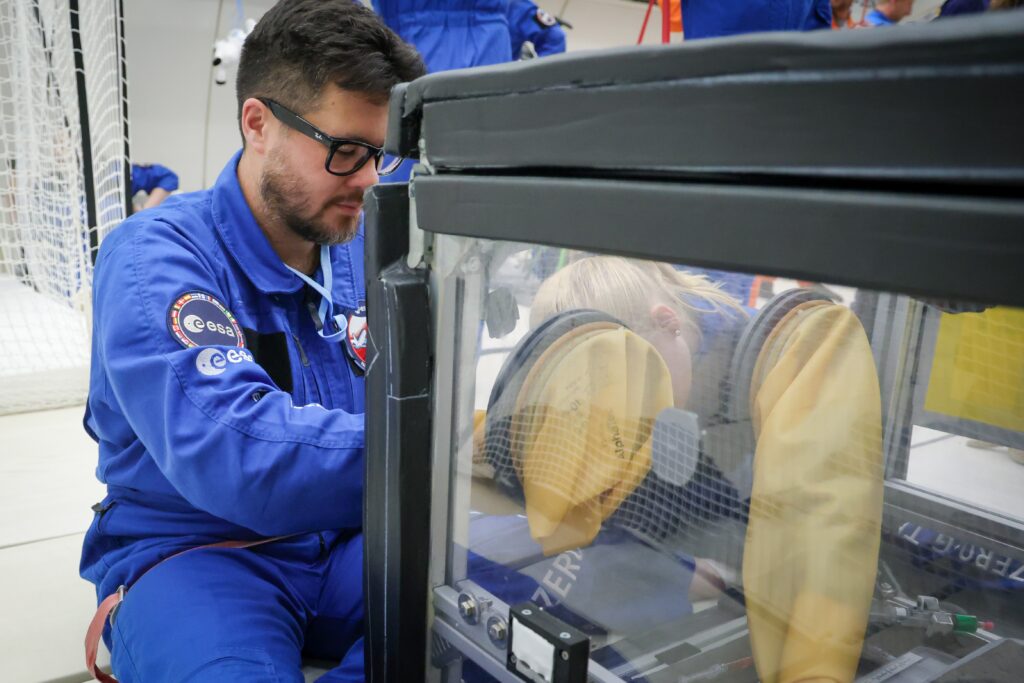
Dr. Turnock: It wasn’t until I was sitting in front of the experiment in the air with my medical student, surrounded by the other research teams, that it all became very real. I had heard many accounts of weightlessness before, but nothing quite prepares you for experiencing it yourself. It is an intense experience. Before and after each parabola, the aircraft experiences 1.8 g, so every part of your body feels twice as heavy. Then, virtually instantaneously, you feel no gravity at all, and every limb is suddenly floating in the air.

Foundation: Where did your interest in space develop?
Dr. Turnock: I always wanted to be an astronaut. And when I was in undergrad, I saw a talk by Dr. Dave Williams, who is now a retired physician astronaut. He made it clear that you didn’t have to be an engineer or pilot to become an astronaut. Really what it comes down to is your leadership ability or personality, ability to work with others, your ingenuity and creativeness.
Foundation: What is your experiment?
Dr. Turnock: Here on Earth, we give most general anesthetics through inhaled gases. In space, though, that’s just not an option. If any of that gas leaked into the cabin, you could end up anesthetizing the whole crew. So, people have looked at other ways of providing anesthetics, either injection anesthetics or through spinal anesthesia. For our experiments, we examined how spinal anesthesia behaves when you take away gravity.
Foundation: Now that you have completed your first experiments, what’s next?
Dr. Turnock: Like all good research, we generated more questions than we answered, and the team is already buzzing with ideas for future research. The thought that we’re going to be doing a surgery in space is far fetched. We’re a long way from doing that. But everything we do now sets the groundwork for 10, 20, 50 years in the future.
About Royal Columbian Hospital
As BC’s most comprehensive critical care hospital, one in three British Columbians rely on Royal Columbian Hospital. We are the only hospital in BC with trauma, cardiac, neurosciences, high-risk maternity and neonatal intensive care on one site. We look after some of the most seriously ill and injured patients, and we do it with the support of donors like you.
Since 1978, donors to Royal Columbian Hospital Foundation have helped fund priority equipment needs, facility enhancements, research, education and innovation at Royal Columbian Hospital. Visit rchfoundation.com for more information.
Learn more:
