
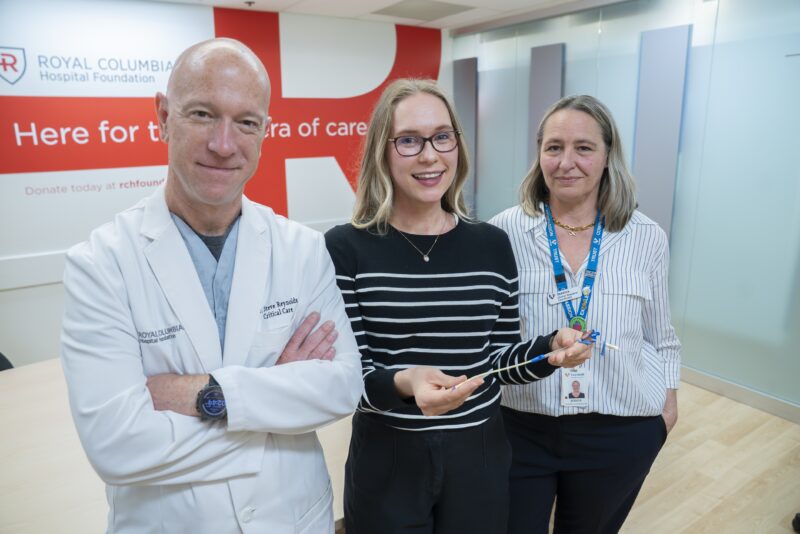
That question became the foundation of the CLiCK trial, a Canadian study led by researchers from Royal Columbian Hospital and Simon Fraser University that was recently published in the Journal of the American Medical Association (JAMA), one of the world’s leading medical journals. The study examined whether a specialized catheter locking solution could reduce complications linked to central lines in adult ICU patients. Researchers found the locking solution was associated with a significant reduction in a composite measure of these complications.
Dr. Reynolds is a Royal Columbian Hospital critical care physician, associate professor at Simon Fraser University and Executive Lead of Royal Columbian Hospital Foundation’s Advancing Innovation in Medicine Institute, known as AIM. Created as a social enterprise, AIM helps health-tech companies move promising innovations from concept to clinical evidence by connecting them with clinicians, researchers and hospital environments.
“We help companies from idea to commercialization by leveraging clinical expertise, research networks and real-world care environments,” Dr. Reynolds says. “Our focus is on improving patient care.”
The institute supports clinical trials, real-world evaluation and funding partnerships, with a particular focus on technologies requiring rigorous evidence before broader adoption. AIM reinvests proceeds back into the healthcare system through Royal Columbian Hospital Foundation.
The CLiCK trial reflects that model in practice.
The study involved 1,468 patients at six Canadian hospitals. Researchers studied whether a four per cent tetrasodium EDTA catheter locking solution could reduce complications associated with central lines, which are used to deliver medications, fluids, antibiotics and nutrition to critically ill patients. The clearest effect observed was a reduction in catheter blockages requiring alteplase, a medication used to reopen blocked lines.
“Central lines are essential for many ICU patients, but complications can interrupt care and result in additional treatment,” Dr. Reynolds says. “Because these lines are used in ICUs around the world, evidence on how to reduce complications can matter beyond one hospital or one health system.”
The study’s first author was Marlena Ornowska, who recently completed her PhD at Simon Fraser University under Dr. Reynolds. Her doctoral work played a central role in coordinating the trial and preparing the publication.
The CLiCK trial is one example of the work AIM supports. The institute has also been involved in research on digital therapeutics, including a study that explored whether a nature-based digital intervention could help reduce agitation in hospitalized patients experiencing delirium, and another evaluating nasal photodisinfection technology for infection prevention in intensive care settings.
For Dr. Reynolds, the broader goal is to create an environment where clinicians, researchers and innovators can work together to rigorously evaluate ideas before they are adopted more broadly across the healthcare system.
“Questions that begin at the bedside can generate evidence with relevance far beyond a single hospital,” he says.
For more information about Royal Columbian Hospital Foundation’s AIM Institute, visit aiminstitutecanada.com