
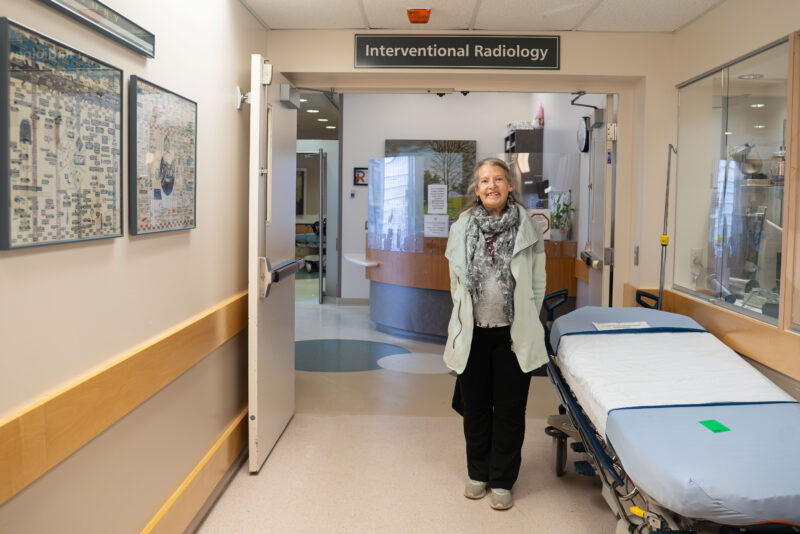
Paramedics arrived quickly and rushed her to Royal Columbian Hospital. Inside the ambulance, Margaret remembers an unusual calm. “It was very quiet,” she says. “I knew something was not right, but I was not scared. I just felt off.”
When Margaret arrived at Royal Columbian Hospital, the stroke team was already waiting. Dr. Zameer Hirji, Interventional Radiologist, had been alerted by Royal Columbian Hospital stroke Neurologist, Dr. Hassanain Toma, before she reached the hospital. “I received the call at 1:06 p.m. that a patient with a high likelihood of a large-vessel stroke was on the way,” says Dr. Hirji. “From that moment, everything moved very quickly. Mrs. Swanson arrived in our ER at 1:08pm and by 1:42 p.m., we had removed the clot and fully restored blood flow to her brain.”
“Removing a clot from someone’s brain within 34 minutes of them entering the RCH doors is remarkable,” Dr. Hirji adds.
Dr. Hirji describes the moment not as frantic, but focused. “There is a calm, urgent rhythm in those situations. Everyone knows their role. When that happens, you can achieve remarkable outcomes.”
Margaret has since learned that it took just 34 minutes from arrival to the completion of the life-saving procedure. “When they told me how fast it all happened, I was amazed,” she says. “I did not even realize things like that were possible.”
The procedure, known as a mechanical thrombectomy, involves accessing a blood vessel through her groin and navigating a catheter or “thin tube” using imaging guidance to the brain to remove the clot. At the time, Margaret had no idea how it was done. “I was fascinated when they explained it to me,” she says. “The technology is unbelievable.”
After the procedure, Margaret regained her speech and mobility quickly. When her two sons visited her in recovery, she was already beginning to feel like herself. “I remember trying to say words and thinking, ‘Why can’t I get this out?’” she says. “But it did not take long before I could talk properly again.”
Dr. Hirji says moments like that never lose their impact. “When you see someone go from being unable to speak or move to walking and talking again, it really stays with you,” he says. “You think about what their life could have looked like without that intervention. It is incredibly humbling to be part of that.”
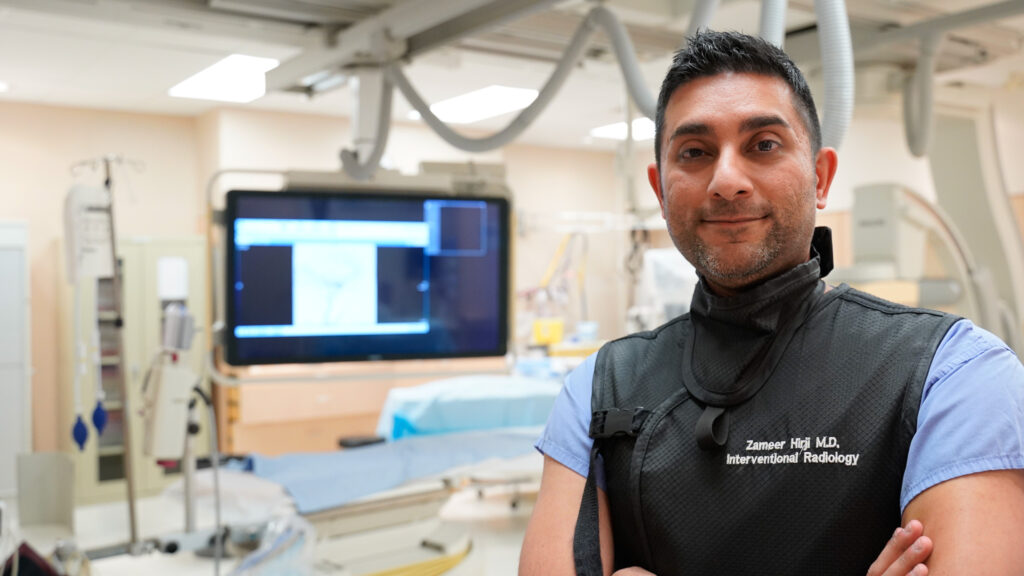
Dr. Zameer Hirji, a leading Interventional Radiologist at Royal Columbian Hospital.
Margaret spent about a week in hospital before returning home. Nurses and staff ensured she was ready to leave safely, checking her strength, balance, and recovery every step of the way. “The nurses were incredible,” Margaret says. “They explained everything, made sure I was okay, and helped me feel confident going home.”
Before her stroke, Margaret lived a very active life. She was a dragon boat paddler, a volunteer, and a gardener who loved being outdoors. While she continues to recover, she remains deeply grateful for the care she received. “I think about it now and I realize how lucky I was,” she says. “If that technology and that team had not been there, I might not be here.”
For Dr. Hirji, stories like Margaret’s are the reason he does this work. “You do not think about the bigger picture in the moment,” he says. “You are focused on getting from the groin to the brain safely and quickly. But when you see that person later, talking, walking, living their life again, that is when it really hits you why this work matters.”
Today, Margaret looks back with gratitude for the quick-thinking gym staff, the paramedics, and the Royal Columbian Hospital team that acted without hesitation. “I am just so thankful,” she says. “It is amazing what they can do. Truly amazing.”

Margaret, grateful for her care, visited the Foundation office to share her story.