
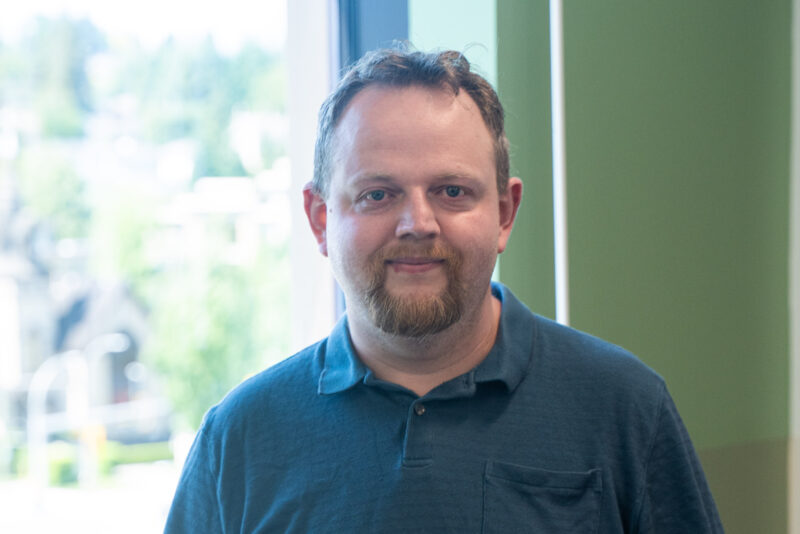
“Everything’s pretty normal until that event happened, and then from there it kind of got a little crazy,” Collin recalls. “I had a stroke. The full-face droop, slurred speech, arms can’t lift up, the whole stroke thing.”
For Collin, the stroke was only the beginning of his medical journey. After receiving urgent care at Royal Columbian Hospital, physicians discovered the underlying cause of Collin’s stroke: a patent foramen ovale (PFO), a small opening in the heart that can allow blood clots to travel to the brain and cause a stroke.”
As a young patient without many traditional stroke risk factors, identifying the source of Collin’s stroke was critical. Closing the PFO would help reduce his risk of another stroke and give him the confidence to return to the life he loves most: being there for his family.
“Well, I just had a little kid,” Collin says. “I just want to be here for her.”
Finding the cause
To reduce his risk of future strokes, Collin underwent a minimally invasive procedure at Royal Columbian Hospital to close the PFO. As part of his treatment, the cardiology team used an advanced robotic-assisted transcranial Doppler (RA-TCD) test to better assess blood flow through the PFO and into the brain.
The technology, supported by donors to Royal Columbian Hospital Foundation, represents an important advancement in stroke care. Royal Columbian Hospital is among the first centres in Canada to use robotic-assisted TCD technology in this way, helping physicians more accurately measure blood flow and identify whether blood is passing through the PFO.
“The robotic-assisted portion of the test was a robotic-assisted TCD, which allows us to measure shunting, or flow of blood through the PFO into the brain,” explains cardiologist Dr. Razi Khan. “TCD is a more sensitive test than standard echo. Robotic assistance allows us to find the best area on the temple to accurately measure blood flow to the brain.”
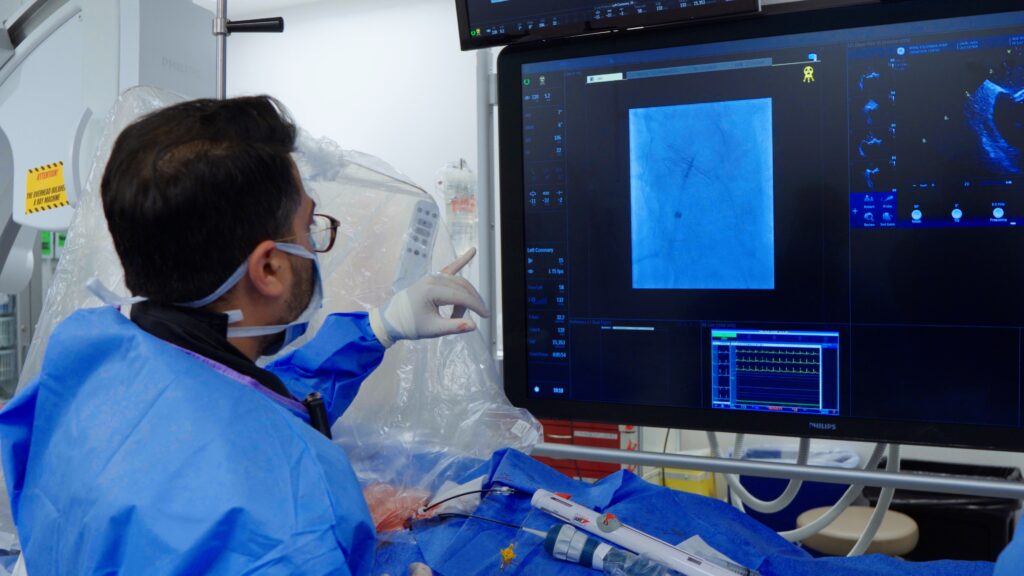
Dr. Razi Khan performs Collin’s minimally invasive patent foramen ovale (PFO) closure procedure at Royal Columbian Hospital. Photo: Joshua Klassen / Fraser Health
A new chapter in care
For Collin, participating in the procedure meant more than receiving advanced care. It also meant helping physicians expand their knowledge and improve care for future patients.
“It felt really good that I could be part of it and then other people can watch the procedure done on me so they can learn and do it to more people and help out with everyone else,” he says.

Collin undergoes a robotic-assisted transcranial Doppler (RA-TCD) test during his procedure, helping physicians assess blood flow through the heart and to the brain. Photo: Joshua Klassen / Fraser Health
Throughout his hospital stay, Collin was also struck by the human side of his care. Beyond the procedures and technology, it was the compassion and support from the healthcare team that stayed with him most.
“The nurses were super nice and super helpful,” he recalls. “Very, very helpful. Talkative.”
Even the small moments stood out during a time that could have been overwhelming. “They helped me find my phone and my headphones. I put them down and then just voofed and then we found them a couple hours later.”
Today, Collin has returned home to his family with renewed confidence about the future.
“It is very gratifying knowing Collin can come home and feel confident he can live a stroke-free life,” says Dr. Khan. “We as cardiologists often treat older patients. Knowing we can have a dramatic impact on a young patient’s life for the remainder of his life is truly special.”
For Collin, the experience is a reminder of how quickly life can change, and how important it is to have access to specialized care when it matters most.
“I’m just thankful that there was that option when it happened to me,” he says. “Because if this was three or four years ago, I don’t know if we’d be talking right now.”