
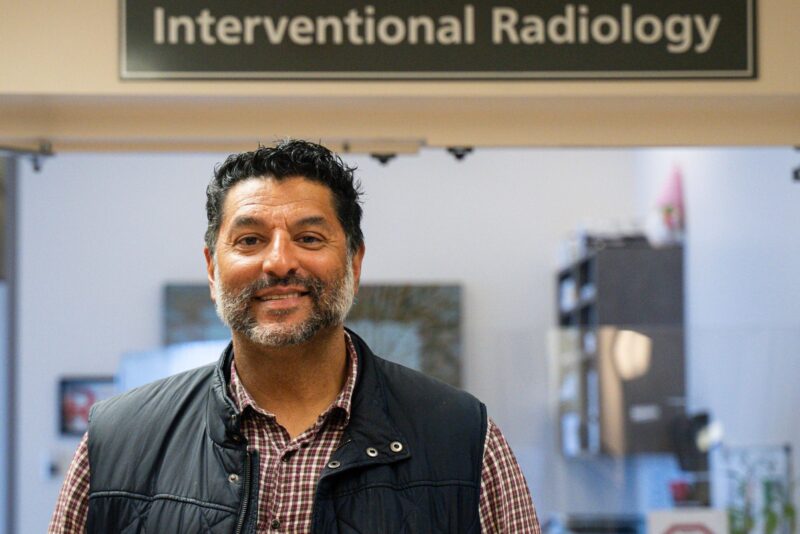
What started as a persistent cough evolved into something far more serious. Although he was initially treated for a suspected chest infection and pneumonia, his breathing continued to worsen.”The doctors had said the previous two days, ‘If you can’t breathe, go to the emergency immediately,'” recalls Jyoti. “I just wasn’t willing to do that. I was thinking, ‘I’m going to sit there for six or seven hours. It’s not going to work.”
One morning, the situation became impossible to ignore. Struggling to breathe and barely able to walk, Jyoti’s family called 911. When first responders arrived, they immediately recognized how critical his condition had become. “They tested my oxygen and said it was 54 per cent,” says Jyoti. “The firefighter said, ‘I thought our monitor was broken because it said 57.’ There’s no reason I should even be conscious.”
Jyoti was rushed to Langley Memorial Hospital before being urgently transferred to Royal Columbian Hospital. There, physicians discovered the cause of his symptoms: a massive pulmonary embolism, a life-threatening blockage caused by blood clots in the lungs. By the time he arrived at Royal Columbian, his condition had become critical.
“When we measured it, it was the highest pulmonary arterial pressure I’ve ever seen in anybody,” explains interventional radiologist Dr. Will Siu. “He was actually imminent of going into cardiac arrest when he came in.”
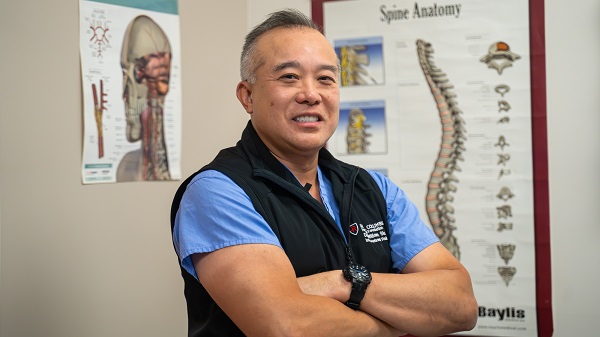
Dr. William Siu is a leading Interventional Radiologist at Royal Columbian Hospital
To save his life, Dr. Siu and his team performed a pulmonary thrombectomy, a minimally invasive procedure that removes blood clots from the lungs using specialized catheters. Royal Columbian Hospital is a leader in this advanced treatment and performs more of these procedures than any other hospital in Canada.
The procedure was carried out while Jyoti remained awake. Despite the urgency of the situation, what stands out most in his memory is the calmness of the team around him. “At no point did I ever feel like there was any stress on me,” he says. “They kept everything so calm in front of me, at least to make me feel like, ‘Okay, it’s okay.’” The results were immediate.
“The impact is phenomenal,” says Dr. Siu. “We see almost instantaneous improvement in a lot of these patients right after we do it.” Within days, Jyoti was discharged from hospital. Within a week, he was walking several kilometres a day. The recovery was a stark contrast to what could have happened had he arrived any later.
Following the procedure, he learned just how close he had come to losing his life. The doctor said, ‘You were very close to cardiac arrest,'” recalls Jyoti. “It was really, really close.”
Today, he has returned to the life he loves, spending time with his family, supporting students, and remaining active in the basketball community. He also carries with him a deep appreciation for the team that cared for him during one of the most frightening moments of his life.
“People say the medical system doesn’t work, but when you’re in trauma, oh boy, it works,” he says. For Dr. Siu, stories like Jyoti’s demonstrate the importance of having access to advanced, specialized care when every minute counts.
For Jyoti, the experience serves as a reminder of how quickly life can change, and how grateful he is that the expertise and technology he needed were available when he needed them most. “I’m just thankful that there was that option when it happened to me,” he says. “Because if this was three or four years ago, I don’t know if we’d be talking right now.”
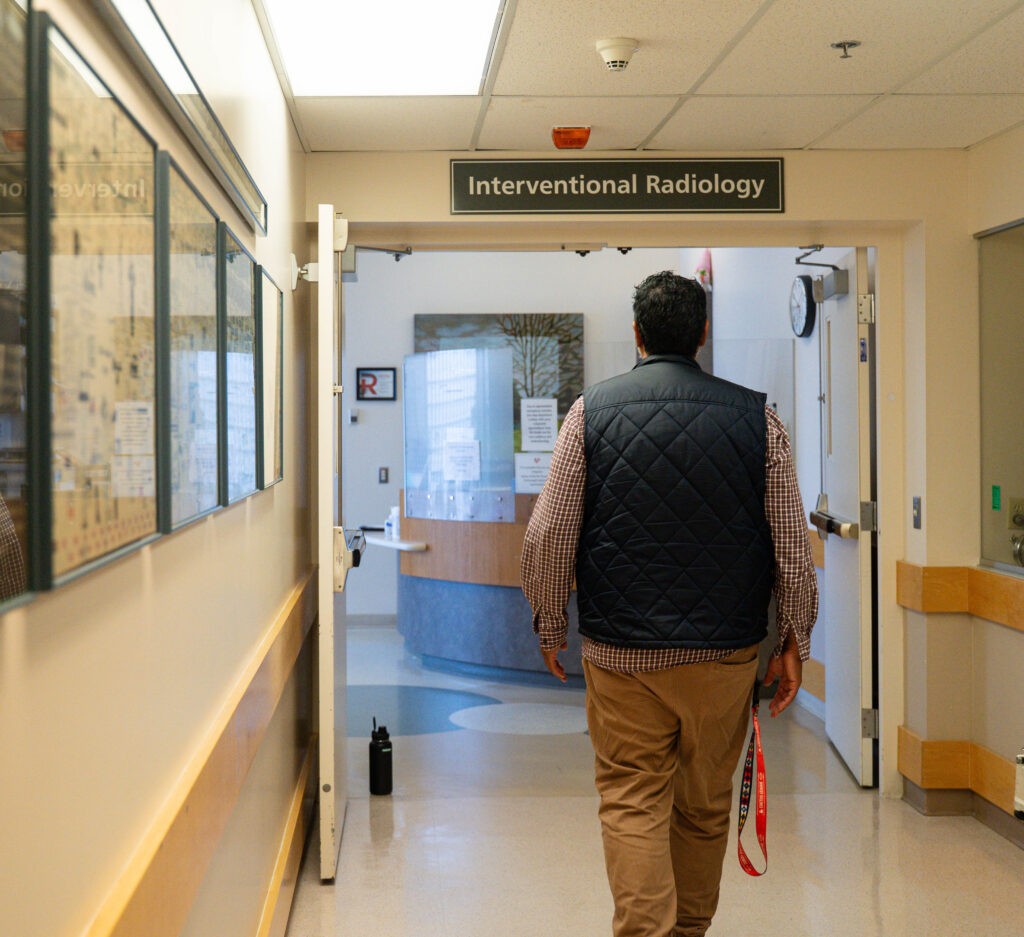
Jyoti visits the department that he credits for saving his life.