

“He kicked me all the time,” says Lauren, recalling her baby’s routine during a joyful but otherwise uneventful first two trimesters before her hospitalization in late May 2025. “I’d wake up every night between two and four, and I knew he was there. But he just didn’t kick me in those hours that day, and he had every night since he could.”
Nothing indicated that Lauren was going into labour, but a fetal heart monitor detected something unusual. “His heart rate, they noticed, would just dip ever so slightly every now and then,” says Lauren. “So they checked me in overnight.”
When Wesley’s heart rate lowered even more, the decision was made to deliver him right away. Weighing just 720 grams, Wesley was rushed to the NICU as Lauren went into recovery.
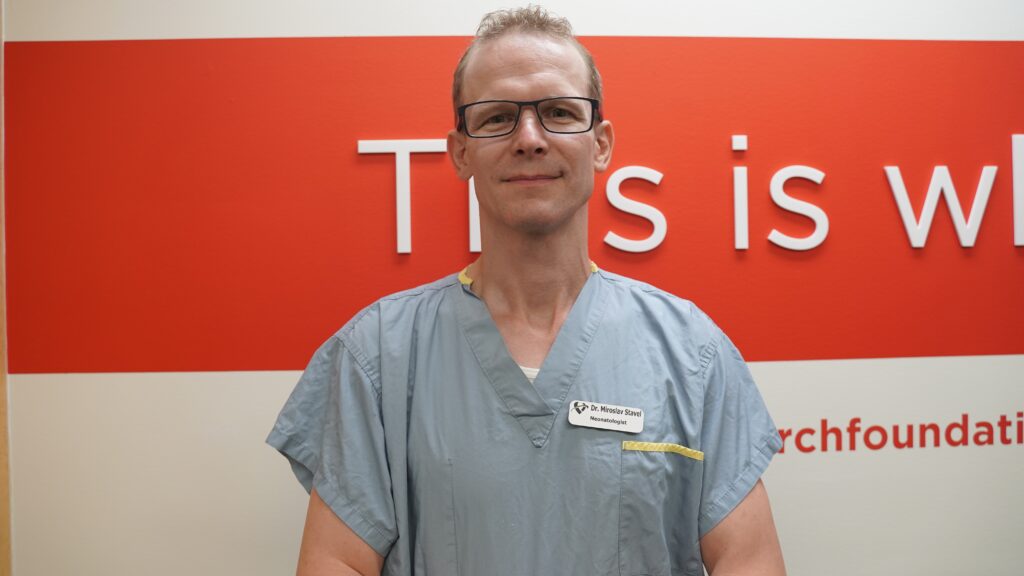
“Once the baby is born, we place them on a warmer and cover the body with the plastic bag to retain the heat,” explains Royal Columbian Hospital neonatologist Dr. Miroslav Stavel. “Then basically, we go through what we call A, B, C. You need to make sure that the airway is secure, the baby is breathing, and that the circulation is working.”
Babies born that early require breathing support such as mechanical ventilation. Wesley was placed on a jet ventilator. Despite the challenge that creates, the neonatal team helped Lauren hold her baby for the first time six days after his birth.
“We need to support families and provide opportunities for bonding with the baby,” says Dr. Stavel. “One well-known intervention is skin-to-skin care. Although simple in principle, in babies born extremely early this often gets delayed. With support of Royal Columbian Hospital Foundation, we developed a setup attached to the jet ventilator, which facilitates providing skin-to-skin care early, even for the smallest and sickest infants.”
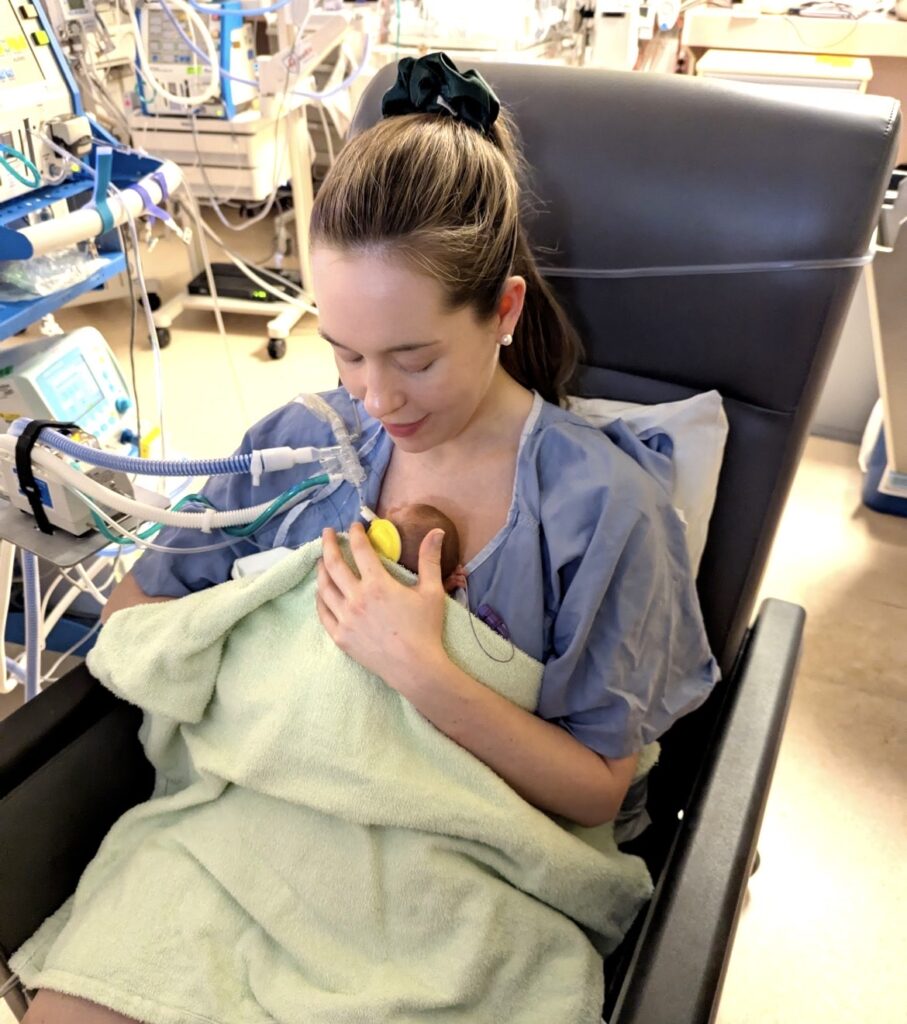
Lauren was scared the first time she held her son while he was intubated but is grateful that she had the opportunity, considering Wesley remained on breathing support for a couple of months. “The bond that we built over those months, I think, is a big reason why he’s been successful, and why we’ve both been able to get through it,” she says.
Lauren also credits the neonatal team for helping them through the start of Wesley’s life. As her baby learned to breathe and feed on his own, Lauren took in the scene around her.
“To have witnessed the amazing people and the miracles that they do, and saving these fragile lives, has been a privilege in a lot of ways, even through the hardest moments,” she says.
The NICU that Lauren came to know so well will have a dramatically new look in the new Jim Pattison Acute Care Tower. The open-concept space of the decades-old NICU will be replaced by 24 single-family rooms, increasing privacy, natural light, and comfort for families.
After more than 125 days in the NICU, Wesley was finally able to go home.
“It’s been a very tumultuous journey, full of five steps forward, two steps back,” Lauren says. “And then at one point it became only steps forward and no steps back. I would like other families to know that the experience is not easy, it is never going to be without bumps, but you have the most amazing team to get you through those bumps.”
